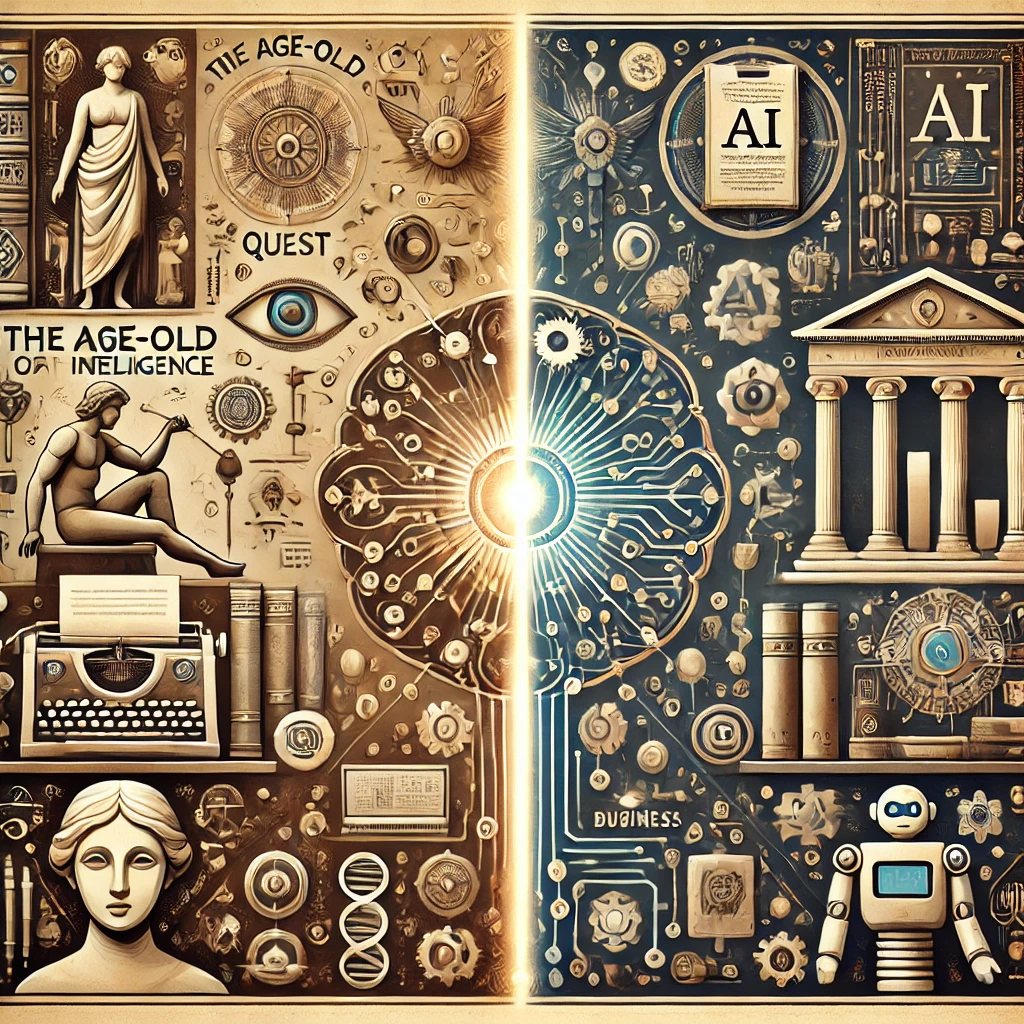
The idea of creating machines that can think, reason and perfects possess consciousness has captivated human minds for centuries. From ancient myths about mechanical beings to early philosophical inquiries, our fascination with Artificial Intelligence (AI) is deeply rooted in history. Yet, this enduring quest raises profound questions: Can we replicate the human mind? And if we can, what does that mean for the future of humanity?
Centuries before the digital age René Descartes, in A Discourse on the Method, posted critical ideas about reason and intelligence and still resonate today. Descartes didn’t have computers, but his philosophical groundwork that would eventually influence the development of AI. His thoughts on the nature of human cognition sparked debates that continues to shape our approach to AI.
Fast forward to present, AI is no longer the topic of philosophical speculation. It has become an integral part of our daily lives, evolving rapidly and reshaping industries, economies and even the way we interact with one another. But how did we get from Descartes’ theories to today’s AI-driven world? and what does the future holds as AI continues to advance at a dizzying pace?
In this blog post, we will take you on a journey through the history of AI, exploring its philosophical origins, Descartes’ pivotal contribution and the incredible advancements in recent years that are changing the fabric of out society. Understanding this history is not only gives us insights where AI might be headed but also helps us grasp the profound impact it’s having on our world.
Ancient Philosophical Roots of AI
The fascination with creating beings that imitate life is almost as old as human civilization itself. Long before “Artificial Intelligence” became a scientific endeavor, ancient myths, legends and philosophical musings revealed an intrinsic human curiosity about building machines capable of thinking, acting, or at least moving on their own. Let’s delve into some of the earliest records of this ideas, from mythical automatons to philosophical seeds of AI planted centuries ago.
A. Early Concepts of Artificial Beings
Ancient Myths and Legends
From the epic stories of Greek mythology to the mysticism of Jewish folklore, ancient legends offer a glimpse into humanity’s early imaginations of artificial life. Consider the myth of Talos, the giant bronze warrior created by the god Hephaestus, which defended the island of Crete. With metal “veins” and molten led in place of blood, Talos was more than just a statue. He was a proto-robotic defender, programmed (in his own mythical way) to protect the island. Talos would circle the shore of Crete, and, at any sign of an intruder, he would heat his metal body until it burned whoever dared to attack.
Moving from Greek to Jewish traditions, we find the story of Golem, a figure in Jewish folklore made from clay an animated from mystical forces. Created to serve and protect its people, the Golem was granted life, but no self-awareness or free will, embodying a form of artificial being that operates under strict instructions without the capacity for independent thought. These mythical beings weren’t exactly “intelligent” in the way we envision AI today, but they reflected an early human urge to explore life’s boundaries and even, perhaps, play at creation itself.
Philosophical References
While legends painted fascinating pictures of artificial life, ancient philosophers took a different route, contemplating the very nature of thought and consciousness. Aristotle considered whether mechanical means could simulate certain aspects of human intelligence. He developed what we would now call “logic,” a system that could, in theory, enable a machine to draw conclusions from a set of rules. This laid the groundwork for the structured, rule-based processes that are core to modern AI systems.
These early musings by Aristotle and his contemporaries didn’t address “machines” as we think of them today. Instead, they planted seeds for later philosophers, who would come closer to framing what we now recognize as the foundation of artificial intelligence. Aristotle’s observations on logic paved a way for philosophers like René Descartes who pushed the boundaries of thought about the mind and body as separate entities-one natural, the other potentially mechanized.
B. René Descartes and AI’s Philosophical Foundation
Fast forward to the 17th century, where René Descartes brought a profound shift to the conversation. In his groundbreaking work, A Discourse on the Method, Descartes put forth ideas that began to distinguish human cognition from mechanical processes in a way that remains relevant to AI.
Descartes’ Contributions
Descartes introduced the concept of dualism, arguing that the mind and body were distinct entities. While the mind was the seat of consciousness, Descartes proposed that the body functioned much like a machine. His insight pushed humanity closer to considering the notion that certain “thinking” tasks could, in fact, be performed by a machine. Descartes speculated that, through a process of mechanization, certain aspects of human action could be reproduced, though he drew the line at true “thought”, which he viewed as uniquely human.
By distinguishing between thought and physical action, Descartes not only help to clarify what it mean to be human but also established a line that, centuries later, scientists would challenge with artificial intelligence.
The Concept of Automata
Descartes’ fascination with the machines led him to the concept of the human body as mechanical system, much like the intricate automata that were growing popular in his time. This automata-beautifully crafted mechanical figures that could perform actions like writing, dancing, or playing musical instruments-showed that complex tasks could be programmed into non-living forms. Descartes used this imagery to illustrate his views of human body as a mechanical device, subject to physical laws and capable of responding predictably to stimuli, like gears in a clockwork.
The metaphor of the automation was influential in setting the stage for viewing the body as a kind of organic machine, one that could be studied, dissected, and understood mechanistically. This conceptions inspired early inventors and later computer scientists, laying philosophical groundwork for the way we design and think about artificial intelligence today.
The Legacy of Early Philosophical AI Concepts
This ancient myths and philosophical musings didn’t just inspire art and fiction; they established a foundation for modern AI. Today’s conversations around and machine learning are the direct descendents of these early stories and theories. The urge to understand, create, and even replicate life runs deep in human history, and from Talos to Descartes’ automata, our ancestor pondered many of the same questions we face now: What makes something truly alive? Can a machine ever think like us? And what responsibilities do we carry if we cross that threshold?
In the world of artificial intelligence, it turns out we’re not pioneers-we’re part of a long, fascinating continuum.
The Evolution of AI: From Theory to Reality
Humanity’s fascination with intelligent machines might have ancient roots, but it’s only in the last century that artificial intelligence has evolved from abstract theory to tangible reality. As we dive into the journey from early 20th century theories to the emergence of machine learning, we’ll explore the key players and breakthroughs that turned AI from a science fiction fantasy into a world-changing technology.
A. Early 20th Century and the Birth of Computer Science
Alan Turning and the Turning Test
Let’s start with Alan Turning, the visionary British mathematician whose work during World War II not only helped crack the German Enigma code but also laid the foundation for modern computer science and artificial intelligence. Turning wasn’t content with machines that simply processed numbers; he wanted to explore if machines could “think”. In 1950, he introduced what we call the Turning Test in his paper “Computing Machinery and Intelligence”. Turning proposed a bold question: Can machine think?
The Turning Test involved a human judge conversing with both a human and a machine through written responses. If the judge couldn’t reliably distinguish between the two, Turning argued, the machine could be considered “intelligent”. The test became a foundational thought experiment in AI, pushing researchers to imagine and ultimately create machines that could replicate or simulate human thought processes.
The Dartmouth Conference (1956)
Jumping forward to 1956, a small but momentous event took place: the Dartmouth Conference, where a group of ambitious scientists formally defined the study of artificial intelligence. Held at Dartmouth College and led by John McCarthy, this meeting marked the official birth of AI as a scientific discipline. Here, McCarthy and his colleagues outlined a vision of AI, believing that “every aspect of learning or any other feature of intelligence can in principle be so precisely described that a machine can be made to simulate it.”
Although the scientists in attendance couldn’t have known the twists and turns AI research would take, their optimism sparked an entire field and led to the development of earliest AI program. With a handful of brilliant minds and a whole lot of ambition, the Dartmouth Conference launched AI from theory into a fledgling but promising field study.
B. Key Milestones in AI Development
The Emergence of Expert Systems
Fast forward to 1970s and 1980s, a period when expert systems came into the scene. These systems were designed to mimic the decision-making abilities of human experts in fields like medicine, geology and engineering. Programs like MYCIN(used for diagnosing bacterial infections) and DENDRAL(used for chemical analysis) were among the first of these systems, applying rule-based logic to specific, complex tasks. Essentially, these systems followed a set of “if-then” rules that emulated the expertise of a human professional.
While expert systems had notable successes, they also had limitations. They were rigid, unable to adapt to new or unexpected scenarios outside their programmed rules. Nonetheless, they proved that AI could be highly specialized and valuable, paving the way for the more flexible and sophisticated AI technologies we see today.
The AI Winters
The enthusiasm surrounding expert systems was short-lived, however, and the field faced challenging period known as AI winters. These were stretches of time, in the 1970s and then again in late 1980s, when interest, funding, and optimism in AI dried up. The initial excitement had led to bold promises, but the technology simply couldn’t deliver on the grand visions people had for it like general purpose robots or conversational machines indistinguishable from humans.
AI researchers struggled with the limitations of the era’s hardware and software, making the lofty goals of the Dartmouth Conference feel far out of reach. As a result, AI funding was slashed, and many scientists pivoted their careers elsewhere. These AI winters underscore the fact that scientific progress, especially in something as ambitious as artificial intelligence, is not always a straight path; it can be a frustrating, challenging journey.
The Rise of Machine Learning
In the 1990s and 2000s, a powerful shift of AI research occurred that would change the field’s trajectory and revitalize its progress; the rise of machine learning. Unlike earlier rule based AI systems that required specific programming for every scenario, machine learning algorithms could “learn” from the data, making them far more adaptable and versatile. This was a game-changer. Machine learning empowered computers to identify patterns and make decisions on their own, based on vast amounts of data.
For example, by training algorithms on millions of images, computers could start recognizing objects within new photos with increasing accuracy. The explosion of digital data along with computing power, along with techniques like neural networks, catapulted AI to new heights, enabling breakthroughs in image and speech recognition, natural language processing and even self-driving technology.
AI’s Journey from Theory to Reality: Looking Ahead
From Turning’s groundbreaking ideas to Dartmouth Conference, from the rise and fall of expert systems to the unstoppable momentum of machine learning, the journey of AI has been marked by visionary achievements and hard-earned lessons. Today, artificial intelligence continues to evolve at an unprecedented pace, reshaping industries and redefining possibilities. Each milestone is AI’s history has brought us closer to a future that, while once only imagined in myth and legends, is now undeniably within reach.
As we look back on these pivotal moments, it’s clear that AI is not just about creating intelligent machines, it’s about expanding boundaries of what technology can achieve and exploring the incredible potential of human ingenuity.
AI in the Modern World: Transformative Applications
Artificial Intelligence has woven itself into the fabric of our daily lives and industries in a way that are both obvious and invisible. From the helpful virtual assistance that turns on your lights to powerful algorithms running the global economy, AI is shaping the world in profound ways. Let’s explore how AI is transforming life as we know it from everyday conveniences to industry-wide revolutions.
A. AI’s Role in Everyday Life
AI in Consumer Products
Look around your home, and you’ll likely find AI quietly working behind the scenes in your favorite gadgets and apps. For starters, there is AI in smartphones, making camera’s intelligent enough to recognize faces and even scenery types for the perfect shot. Virtual assistants like Siri, Alexa and Google Assistance are now household names, responding to commands and offering seamless help with just a simple voice request. From setting reminders to controlling smart home devices, they have become personal butlers, accessible to nearly anyone with a smartphone or smart speaker.
Another area where AI shines is in personalized recommendations. Whether you’re watching movies on Netflix, shopping on Amazon, or scrolling through social media, AI is busy analyzing your preference to offer customized suggestions. This personalized experience, driven by algorithms that predict what you’ll like next, has reshaped our habits and even the way we consume content.
AI in Healthcare
Few fields benefit from AI’s capabilities quite like healthcare. With the vast amounts of data generated by patients records, research and diagnostic results, AI algorithms excel at finding pattens that may escape even the sharpest human eyes. AI-powered diagnostic tools are now assisting doctors in reading imaging scans, sometimes identifying issue such as tumors or fractures more accurately than traditional methods.
AI has also made strides in treatment planning and personalized medicine. For example, machine learning models can analyze a patient’s unique genetic profile and health history to help tailor medications and treatments that offer the best chance of success. By processing and interpreting vast datasets, AI is paving the way towards a more accurate, personalized healthcare approach, making treatments safer, faster and more effective.
B. AI’s Influence on Industries
Automation and the Workforce
AI-driven automation is revolutionizing industries, from manufacturing to logistics. Factories equipped with smart robots can perform repetitive, precise tasks with remarkable efficiency, reducing costs and boosting productivity. But it’s not just about robots building cars—AI’s influence is reshaping the job market itself. As AI takes over more routine tasks, the demand for human labor in these areas is decreasing, while new jobs are emerging in fields like AI programming, maintenance, and data analysis.
This shift has also led to a change in skill requirements. Skills like problem-solving, creativity, and emotional intelligence are becoming increasingly valuable as machines handle the more predictable tasks. Companies are focusing on retraining employees and adapting to a landscape where humans and AI work side by side. While automation does bring challenges, it also offers opportunities to build a workforce equipped for the future.
AI in Finance and Business
AI is a powerhouse in the world of finance and business. Algorithmic trading using AI to make high-speed trading decisions based on real-time data has transformed stock markets, allowing trades to occur in fractions of a second. Meanwhile, AI’s data-crunching abilities are essential for fraud detection. By analysing transaction patterns, AI can identify anomalies that might indicate fraudulent activity, enabling financial institutions to respond swiftly and safeguard customer funds.
Customer service has also seen an AI makeover. Chatbots and virtual agents, powered by natural language processing, can handle routine inquiries, assist with troubleshooting, and guide customers through processes without a human operator. This doesn’t just make customer service more efficient; it also frees up human representatives to focus on more complex or emotionally sensitive interactions, improving overall customer experience.
AI’s Impact on Our Lives and Future
AI has come a long way from theory to everyday reality, influencing how we live, work, and interact. Whether it’s a smart assistant helping you find a recipe or an algorithm flagging a suspicious bank transaction, AI has found its way into nearly every corner of modern life. And while AI continues to drive changes in how industries operate, it’s also reshaping the job market, leading to new skills and opportunities.
From personalized entertainment to breakthroughs in medicine, AI’s transformative power is only beginning to show its full potential, offering exciting possibilities and fresh challenges as we shape the future with technology by our side.
The Ethical and Philosophical Implications of AI
As AI becomes more sophisticated and embedded in our lives, it raises significant ethical and philosophical questions. How can we create fair and unbiased AI systems? What does it mean for privacy in a world where data is currency? And, going deeper, can machines ever truly “think” in a way comparable to human consciousness? Let’s dive into the thought-provoking landscape of AI’s ethical and philosophical dimensions.
A. Ethical Concerns
Bias and Fairness in AI
One of the biggest ethical issues facing AI today is algorithmic bias. Because AI learns from data generated by humans, it can also inherit our biases. For instance, facial recognition systems trained on predominantly lighter-skinned faces have been shown to perform poorly with darker-skinned individuals. This bias isn’t just a technical flaw—it can lead to serious real-world consequences, from unfair hiring practices to misidentifications in law enforcement.
Efforts to create fair AI systems include diversifying the datasets used to train algorithms and implementing transparency in AI decision-making processes. However, achieving true fairness in AI is challenging, as even the best datasets and methods can be imperfect reflections of society. As we push forward, addressing these biases will be essential to building trustworthy AI that serves everyone equitably.
Privacy and Surveillance
With AI’s ability to analyze vast amounts of data, privacy concerns are at an all-time high. From social media platforms to smart home devices, AI is collecting data on our habits, preferences, and even our personal conversations. While this data can create useful services, it also poses significant risks to our privacy. Many people worry about the implications of constant surveillance, especially as AI enables the identification and tracking of individuals on a large scale.
The potential use of AI for surveillance, particularly by governments or corporations, raises serious questions about freedom and civil rights. What happens when AI systems become so powerful that they know more about us than we’re comfortable sharing? Balancing the benefits of AI-driven insights with the need for personal privacy is a debate that will likely intensify in the years to come.
B. Revisiting Descartes: What It Means to Think
Can Machines Truly Think?
To explore whether AI can “think,” let’s revisit René Descartes, who famously questioned the nature of mind and consciousness. Descartes argued that the human mind and body were separate, with the mind possessing qualities machines could never replicate. Today, AI has made leaps that Descartes couldn’t have imagined—yet the question lingers: Can machines truly think?
While AI can simulate aspects of human thought, such as pattern recognition and decision-making, it operates fundamentally differently from a human brain. Machines process data, but they lack self-awareness, emotions, and subjective experiences—at least for now. This brings us to a profound philosophical question: Does “thinking” require consciousness, or is it simply a matter of processing information? Until AI achieves some form of self-awareness (if that’s even possible), it’s unlikely to replicate the depth of human thought fully.
The Future of Human-AI Interaction
With AI progressing at a rapid pace, our relationship with these intelligent systems is bound to evolve. Today, we use AI as tools or assistants, helping us streamline tasks and solve complex problems. But as AI continues to advance, our interactions could grow more complex and collaborative. Imagine a future where AI systems act not just as assistants but as creative partners, collaborators, or even friends.
This evolution raises new questions: How will we treat these increasingly sophisticated machines? Will we grant them certain rights if they begin to show signs of consciousness? Our future with AI may lead us to redefine what it means to be human and how we coexist with machines that, in some ways, mirror our own intelligence.
Reflecting on the AI of Tomorrow
As AI continues to permeate our lives, it challenges us to grapple with both ethical dilemmas and age-old philosophical questions. From ensuring fair algorithms to respecting privacy and questioning the nature of thought itself, AI is pushing us into new intellectual and moral territories. The way we navigate these challenges will shape the future of our relationship with AI—and ultimately, what it means to be human in a world shared with increasingly intelligent machines.
Conclusion: AI’s Past, Present, and Future
Artificial Intelligence has taken a remarkable journey, one that began with philosophical musings and has evolved into transformative technologies that shape our world. From ancient myths and early logic to today’s self-learning algorithms, AI’s development is a story of human curiosity, ingenuity, and ambition. Let’s wrap up by revisiting AI’s historical journey, reflecting on its current impact, and looking ahead to the questions it will pose for our future.
A. Recap of AI’s Historical Journey
AI’s roots are planted in the fertile soil of philosophical thought. Thinkers like Aristotle and, centuries later, René Descartes laid foundational ideas by questioning the nature of human thought and imagining mechanical beings. Descartes’ famous mind-body dualism—where he proposed that the mind and body are separate entities—encouraged future thinkers to imagine “thinking” machines, setting the stage for later AI pioneers. Fast forward to the 20th century, where Alan Turing’s theories and the landmark Dartmouth Conference officially launched AI as a field of scientific inquiry.
Since then, AI has evolved from limited rule-based systems to today’s complex machine-learning models, each advancement building on the philosophical foundations laid long ago. In tracing AI’s roots, we see a continuous quest to explore human intelligence and understand the nature of thought itself—a journey that has led us to the sophisticated AI systems we interact with daily.
B. The Ongoing Impact of AI
Today, AI’s influence is everywhere. From smartphones that know our routines to medical diagnostics that save lives, AI is deeply embedded in our society, driving efficiency, convenience, and sometimes controversy. Historical milestones, like the development of the Turing Test and expert systems, serve as the bedrock upon which today’s innovations stand. These past achievements continue to influence AI’s role, as researchers draw from earlier successes and failures to push the technology forward.
The ethical and philosophical implications of AI are now a part of mainstream discourse. Issues like bias in algorithms and privacy concerns prompt us to ask tough questions about how we shape and use AI. It’s a reminder that AI’s development is not only a technological journey but also a reflection of human values and choices. The decisions we make about AI today are grounded in its history and will determine its role in our future.
C. Looking Ahead
As we look to the future, AI promises both breathtaking advancements and complex challenges. With the potential for increasingly “intelligent” systems, questions about ethics and philosophy will become even more pressing. Can we create fair and unbiased AI? How do we balance AI’s capabilities with our right to privacy? And, perhaps the biggest question of all: If AI were ever to achieve a form of consciousness, how would that change our understanding of humanity?
The journey of AI is far from over, and as it continues, each of us will play a role in shaping its path. By staying engaged with the ethical and philosophical questions AI raises, we contribute to a thoughtful and responsible AI future. AI might have started as a concept in philosophy, but its impact is now ours to guide. Let’s embrace this journey with open eyes, curious minds, and a commitment to creating technology that aligns with our shared values.
With AI’s past as our foundation, its present as our playground, and its future as a realm of endless questions, the story of AI is truly just beginning.